

Usha Yarns Secures Growth Equity Investment from Fullerton Carbon Action Fund
July 15, 2026
The Next Milestone in Textile Recycling Isn’t Innovation. It’s Adoption
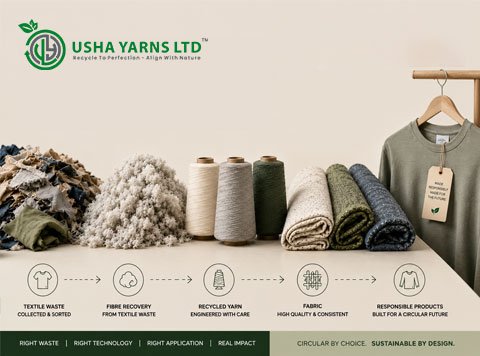
Over the past decade, textile recycling has moved from the margins of the industry toward the mainstream.
Brands have announced ambitious recycled-content targets. New recycling technologies have emerged. Investment in circularity has grown, and recycled materials are increasingly becoming part of mainstream sourcing conversations.
These developments represent genuine progress.
Yet, as we engage with brands, recyclers, mills, manufacturers, and other partners across the textile value chain, one question keeps returning:
How do we move from proving that textile recycling can work to making recycled materials work at scale?
The challenge is no longer simply whether textile recycling is technically possible.
The bigger challenge is understanding where each recycling pathway creates the greatest value—and defining the right applications, specifications, and standards to enable wider adoption.
At Usha Yarns, nearly three decades of experience in mechanical textile recycling have taught us an important lesson:
Building a circular textile industry may not depend on waiting for one perfect recycling solution.
Instead, it may depend on understanding the capabilities of the solutions already available—and applying each where it can deliver the greatest environmental, technical, and commercial value.
Mechanical recycling, chemical recycling, fibre-to-fibre technologies, and emerging recycling pathways each have different strengths, feedstock requirements, output characteristics, and ideal applications.
The opportunity is not necessarily to choose one over another.
It is to build a recycling ecosystem in which the right waste stream meets the right technology, the right material specification, and ultimately, the right application.
This is where we believe the next phase of circularity must focus.
The industry has spent significant time proving functionality. Now, the priority must shift toward adoption and standardization:
• Defining fit-for-purpose applications for recycled materials
• Establishing clear and realistic material specifications
• Aligning quality and performance expectations across the value chain
• Designing products with recycling pathways in mind
• Creating stronger and more consistent demand for solutions already ready to scale
Innovation will, of course, remain essential.
But innovation alone will not create circularity.
Circularity becomes real when solutions move beyond pilots, enter recurring supply chains, specifications are locked in, and recycled materials become a standard sourcing choice rather than an exception.
Perhaps the next milestone for textile recycling is not another breakthrough.
Perhaps it is turning what already works into what the industry routinely uses.
At Usha Yarns, we believe this transition—from innovation to implementation, and from pilots to scalable adoption—will define the next chapter of textile circularity.
If you work anywhere across the textile value chain, we would value your perspective:
Which recycling pathways do you believe are ready to scale today? Where do you see the biggest gaps in standards and specifications? And what would most accelerate adoption in your part of the industry?
#TextileRecycling #CircularTextiles #CircularEconomy #RecycledYarn #TextileCircularity #MechanicalRecycling #SustainableTextiles #FiberToFiber #CircularFashion #UshaYarns